Soul Connection · Conversation · Listening
The questions were ready. Why does the real conversation keep escaping?
Indrajit Lahiri’s winding conversation offers a practical lens for preparing deeply without turning a guest into raw material for a predetermined script.
The question list was ready, but the conversation moved elsewhere
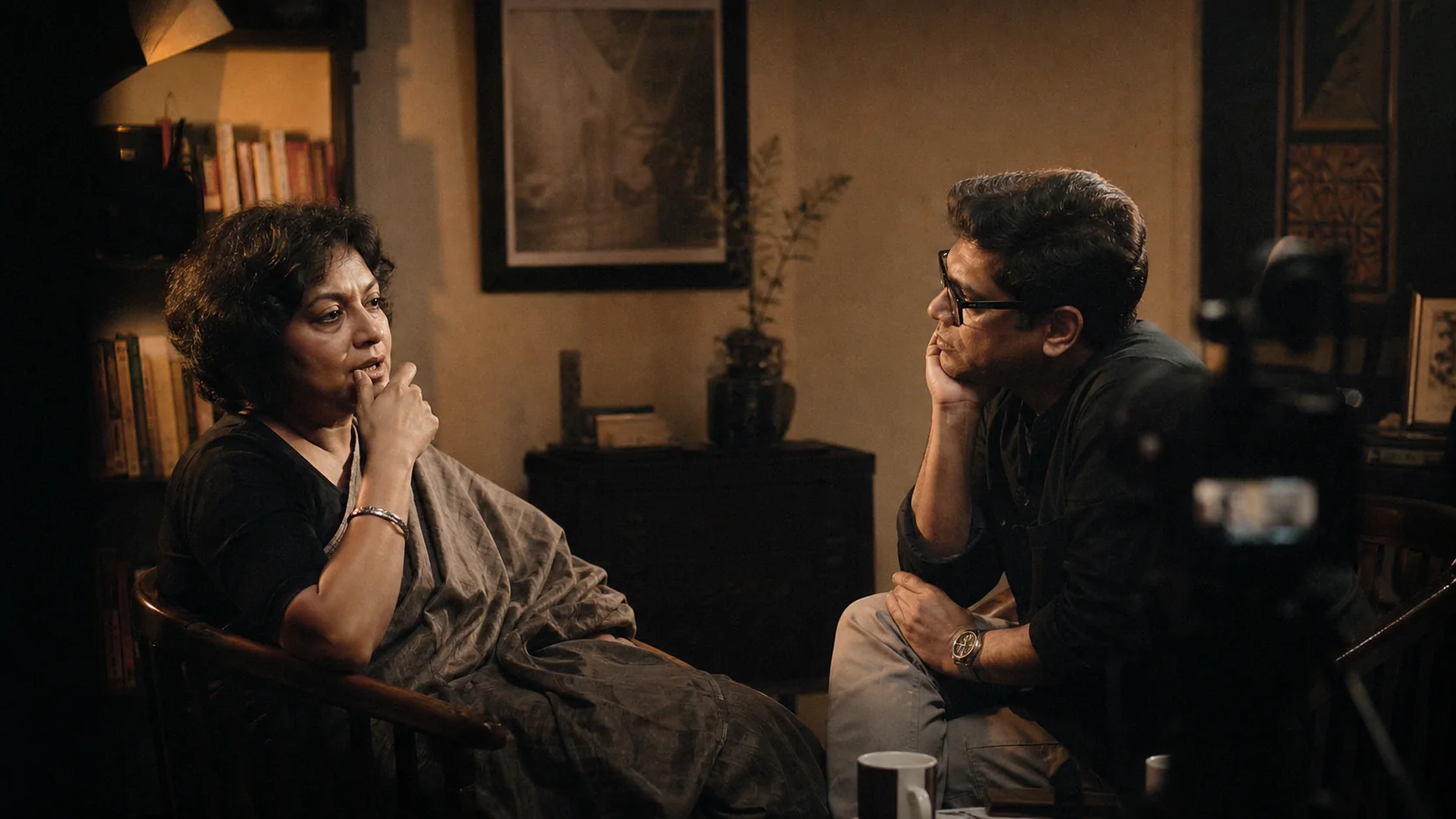
A sheet of questions can look reassuring beneath a studio light. It promises that silence will never last too long, that the episode will reach every planned subject, and that the host will not appear unprepared. Then a guest answers one question by opening a door that was not on the sheet. His voice changes. He adds a detail, retreats from it, and leaves a small pause. The host has a choice. Follow that movement, or look down and ask question number six. The recording will continue either way. Only one choice keeps the conversation alive.
Indrajit Lahiri enters the Soul Connection episode through a wonderfully inconvenient observation. He describes looking at successful podcast formats and seeing a host ask questions that could sound foolish even though they had clearly been scripted for a domain expert. He is not making a clean argument against research. His own account is full of research, calculation and business reasoning. The discomfort sits elsewhere. A prepared question becomes foolish when it survives contact with an answer unchanged. This episode earns its title because it does not remain a discussion about interviewing. It moves from a failed podcast to creator economics, platform dependence, viral humiliation, children and quick fame, the price of food, nostalgia, hygiene and the difficulty of leaving while applause still exists.
Three ledgers inside one interview
Verify the biography, work, context and contradictions. This ledger belongs to preparation.
Track the guest’s words, pauses, uncertainty and unexpected doors. This ledger belongs to the live encounter.
Separate numbers, claims and incomplete context for verification. This ledger belongs to editorial responsibility.
Preparation is a map, not a railway track
Without research, an interviewer spends the encounter collecting facts that should have been known before the lights came on. Indrajit’s hotel-management training, the early kitchen exercise of peeling a vast quantity of onions, his years in sales and his long relationship with food writing all change the meaning of Foodka. It is not merely a popular channel. It is the meeting point of appetite, storytelling, operational knowledge, performance and a salesman’s instinct for an unserved market. Preparation makes those connections visible.
A map becomes dangerous when it is mistaken for a railway line. Arunava’s question about why a creator begins leads Indrajit through several possible motives: free access, fame, money, love of a subject and the recognition of a business gap. He does not insist that one motive is morally pure. He insists that the creator should know the motive and then confront the practical question of how the work can continue. The route changes from personal intention to Mir, Foodka, sponsorship and production costs, yet the governing question remains coherent.
The most revealing turn occurs when Indrajit considers whether his podcast failed because podcasting was not his first love. The market explanation is not enough. Perhaps the camera registered that difference before he did. A mechanical interviewer could acknowledge the confession and move to the next venture. A listening interviewer notices that the guest has shifted from strategy to self-doubt. The next question now belongs to that uncertainty, not to the original list.

When an answer earns ownership of the next question
The conversation later compares a social platform to a rented house. It can provide visibility and income, but the owner can change the terms or close the building. Indrajit describes an ecosystem around Foodka that extends beyond public videos into production work, consulting and education. The business lesson is straightforward: dependence on one platform is dangerous. The listening lesson is subtler. If the platform delivered the audience, when does that audience become a community the creator can responsibly call his own?
A modern host is tempted to edit while listening. Which sentence will become the thumbnail? Which disagreement can be extracted into a short? Which moment will generate comments? This instinct is understandable because an episode must travel after it is recorded. It becomes corrosive when the guest is treated as a supply of clips. Indrajit presents digital platforms as both democratising and precarious. They gave creators a way to speak and build recognition. They are also rented ground. A sharp clip that removes either side no longer carries his position.
Listening protects contradiction long enough for it to become informative. A guest who depends on a platform while warning against dependence is not necessarily being inconsistent. He may be describing the actual shape of creator work. The useful follow-up is not a prosecutorial “which is it?” It is a question that becomes possible only because both truths were heard: what practices turn borrowed visibility into a durable relationship without pretending that an audience can be owned?
A food conversation revealed the ethics of attention
When the episode reaches food content, it also reaches the economy of anger. Indrajit recalls a comment thread under a mutton nihari video that abandoned the food and became a fight over halal and jhatka. His interpretation is that people sometimes arrive on social media carrying frustrations from elsewhere. But he does not place responsibility on viewers alone. Creators repeat what attracts attention; audiences receive more of what they repeatedly reward. The loop cannot be understood by choosing one villain.
The discussion of cringe content continues this refusal of an easy culprit. No one forces a viewer to watch, share, abuse and then watch again. Yet viral performance also changes the creator. Repetition becomes more extreme, fame distorts self-assessment, and a person whose worth has been organised around reaction may be unprepared when reaction disappears. A scripted binary about whether cringe is good or bad would miss the harder question: what kind of self must be performed each day to keep an incentive loop alive, and how long can that self survive?
The human cost becomes sharpest in Indrajit’s account of online appearances with his young son during lockdown. The videos attracted attention, and brands offered substantial money to place the child in advertising. He stopped. His concern was that childhood fame might vanish as the child changed, leaving him to carry the loss before he had the tools to understand it. This is Indrajit’s decision and interpretation, not a universal parenting law. It nevertheless transforms attention from a neutral metric into a force that can arrive too early and behave like debt.
Host power, necessary preparation and the risk of listening
An interview is never an equal room. The host chooses the invitation, opening frame, edit, title, thumbnail and moment of publication. The guest supplies time, knowledge and sometimes reputational risk. That imbalance makes listening more than good manners. It is an editorial duty not to convert every answer into evidence for the host’s preferred thesis. Yet listening cannot mean surrender. A host must protect time, clarify facts, challenge convenient evasions and stop harm. The ethical distinction is not between interruption and silence. It is between an interruption that helps the thought become more exact and one that merely allows the host to display control.
There is also a seductive myth around the “unscripted” conversation. Lack of preparation can masquerade as authenticity. It often leaves the guest repeating a familiar publicity story while the host celebrates the flow. Serious preparation creates the possibility of freedom because it removes the need to spend twenty minutes discovering basic facts on camera. But preparation has a cost when the research is treated as a verdict. The host begins searching for confirmation rather than surprise. A disciplined interviewer must therefore hold two incompatible obligations at once: know enough to recognise what matters, and remain uncertain enough to be changed by what is heard.
The question that did not exist before recording began
This is not only a podcast problem. It appears in meetings, classrooms, medical appointments, family arguments and every message thread in which a reply is composed before the other person has finished. A practical method begins with two notes beside every planned question: what do I genuinely need to learn, and what answer would make me abandon the route? During the conversation, record exact turning points rather than drafting the next performance. Afterward, separate interpretation from claims that require checking. The method slows the host down without making the exchange shapeless.
A strong interview may end with questions still unused. That is not evidence of poor planning. It may be evidence that two prepared minds produced a third path neither could have written alone. The microphone does not create that event. It only records whether it happened. The harder measure of the host is therefore not how many clever questions were delivered, but whether one answer was allowed to alter the architecture of the hour.
Specific takeaways
- 01
Beside every planned question, write what kind of answer would make you change course.
- 02
Verify basic biography and public claims before recording so the interview does not spend its best time discovering obvious facts.
- 03
Build the follow-up from the premise that changed, not merely from the guest’s final word.
- 04
In live notes, track pauses, self-corrections and contradictions as carefully as quotable lines.
- 05
Before interrupting, ask whether you are clarifying the thought or displaying control.
- 06
Keep the guest’s claim, the host’s interpretation and independently verified fact in separate editorial ledgers.
- 07
Before cutting a clip, check whether the qualification or opposing truth has disappeared.
- 08
Do not measure success by questions completed; ask whether the encounter produced one question neither person had before.
Questions for your own life
- In which recent conversation did you begin composing your reply before the answer had finished?
- Where might your favourite prepared question narrow the guest’s thought?
- Which signal are you reading as audience truth even though it may also be a platform incentive?
- Does your interruption clarify the other person’s thought or establish your authority?
- What question could emerge only after the meeting or recording has already begun?
The questions were ready. Why does the real conversation keep escaping?
Watch the complete episode ↗
Arunava Khasnobis
In Soul Connection, Arunava looks at people, art, relationships, failure, moral tension and inner life through conversation. His essays are not episode summaries; they are honest returns to what was heard, tested against his own questions, experience and unfinished understanding.
CONTINUE READING