Soul Connection · Epic · War
If the war is just, why does it require so much injustice?
Kurukshetra contains a claim to justice—and broken rules, revenge and invisible deaths. Does a just cause make every method sacred?
The dangerous adjective placed before a war
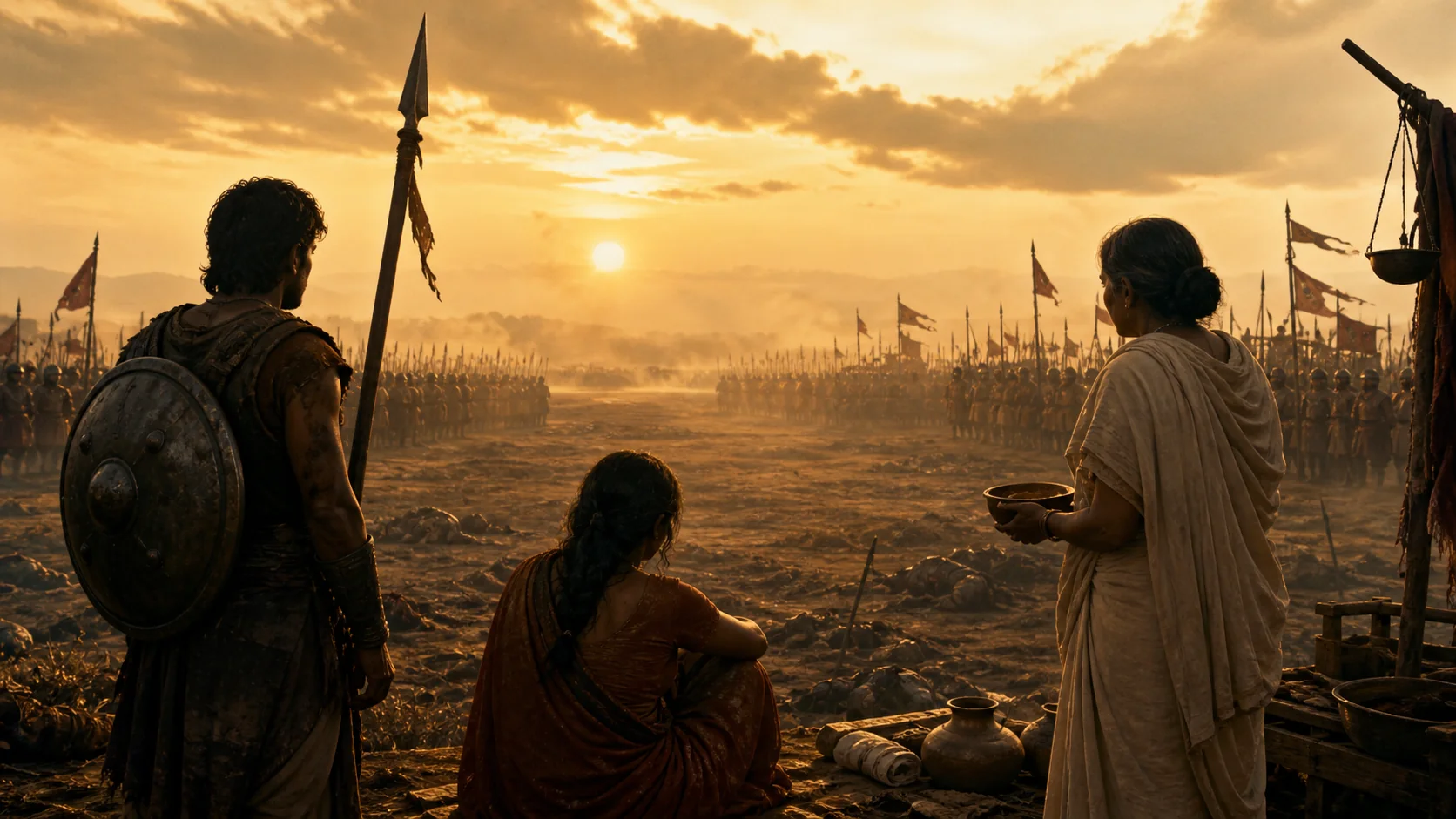
Before Kurukshetra becomes a field of heroes, imagine it as a place of ordinary labour. Someone fills water vessels before dawn. Someone repairs a wheel. A young fighter checks a strap with hands that may never have touched the dice that began this chain of humiliation, exile and refusal. None of these people decided how the kingdom would be divided. Yet once the conches sound, their lives enter a claim made in the name of dharma. That change of viewpoint matters. The familiar question asks which side possessed justice. The human question asks who was required to pay for it.
The earlier short essay asked whether a war called dharmayuddha could truly remain on the side of dharma. A longer reading cannot be satisfied by a yes or no. It has to separate at least four judgments: the justice of going to war, the seriousness of attempts to prevent it, the limits observed during combat, and the order created after victory. The Pandavas' grievance was not imaginary, and Duryodhana's refusal was not morally neutral. But a justified grievance cannot automatically sanctify every tactic used in its name. The epic becomes most useful when it prevents cause and conduct from collapsing into one another.
Four questions before a war can borrow the language of justice
Was a serious wrong being resisted, and were credible paths to peace exhausted?
Did necessity remain limited, or did it become a licence for every useful tactic?
Whose body, family and future paid for decisions they did not make?
Did victory lead to mourning, accountability and repair, or only a new owner of power?
Before the first arrow: peace, dignity and the five-village proposal
The Udyoga Parva preserves more than a march toward inevitability. It records negotiation, counsel and a striking reduction of demand. Yudhishthira is prepared to accept five villages rather than insist on the full restoration of power. This does not erase the history of dispossession; it tests whether coexistence is still possible. Duryodhana's refusal therefore carries more than territorial meaning. It rejects a settlement in which the Pandavas could retain even a minimal political dignity. A war may be called unavoidable, but the moral inquiry must still ask who worked to make alternatives impossible and who accepted real compromise before force began.
Draupadi complicates any easy celebration of compromise. A bargain over land does not by itself answer the violence done to her in the court. Peace and justice overlap, but they are not identical. A settlement can stop armies while leaving the injured person outside the room where terms are written. Her presence forces another question: whose consent is being traded when leaders announce reconciliation? Revenge cannot become the whole content of justice, because revenge multiplies victims. Yet peace that demands silence from the humiliated is only stability arranged around an unhealed wound. A credible peace process must hold both survival and dignity.
Broken rules and necessary strategies: the moral residue of winning
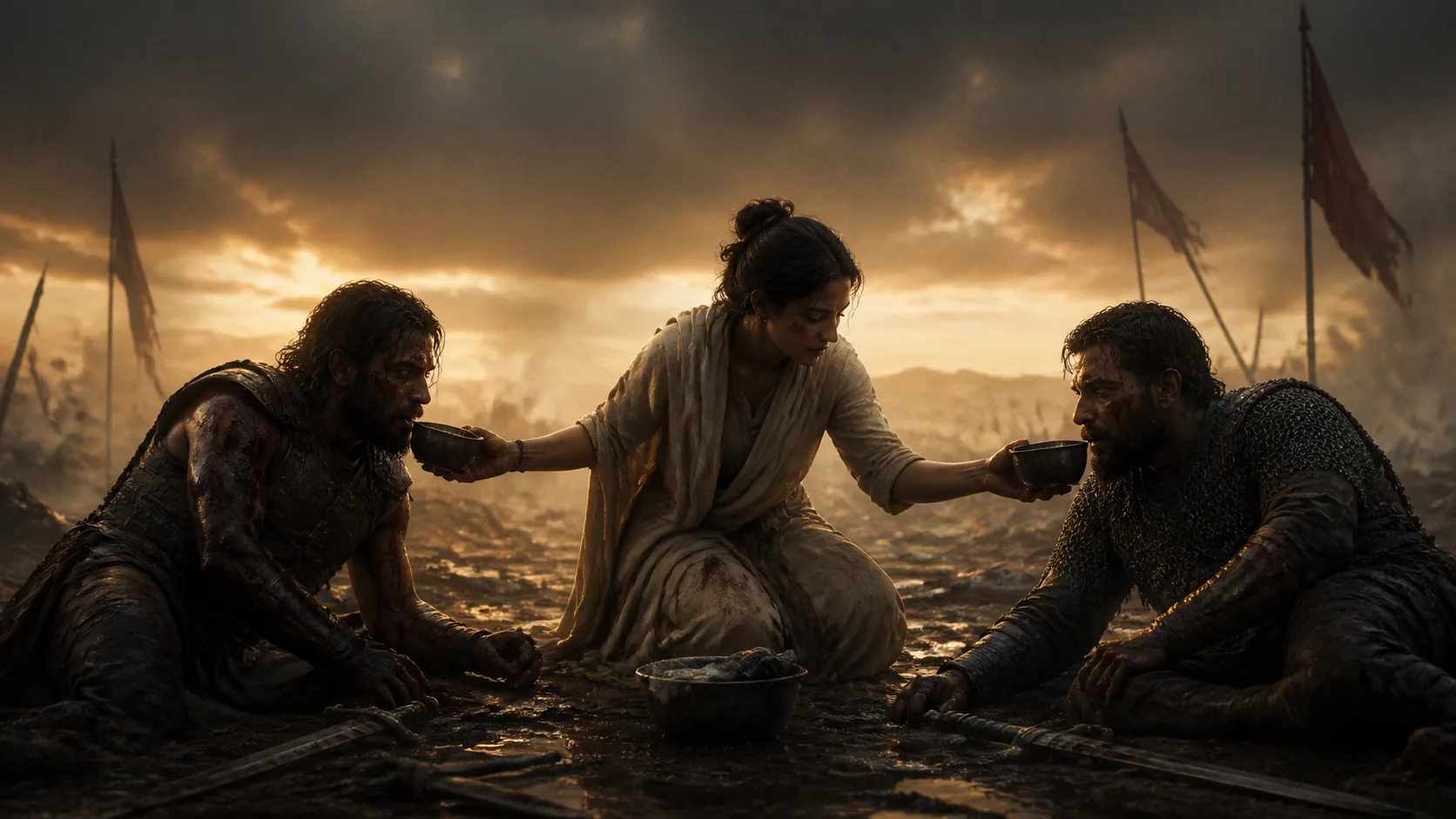
Once battle begins, the Mahabharata refuses to preserve the winners in moral glass. Shikhandi's position before Bhishma, the message about Ashwatthama that breaks Drona, Karna's vulnerable moment, and the blow to Duryodhana's thigh are not interchangeable episodes. Each has a different threat, history and set of alternatives. Context matters. Still, context does not turn a departure from an accepted rule into simple obedience. Necessity may explain why a tactic was chosen. It does not remove the remainder: the trust used as a weapon, the line crossed, or the precedent left for those who will later claim their own emergency.
The episode involving Drona is especially severe because language itself becomes a method of combat. Yudhishthira's credibility gives the statement about Ashwatthama its force. A fragment of factual accuracy is arranged to produce a false conclusion in the listener. The battlefield emergency is real; so is the deception. Moral seriousness requires both to remain visible. Sometimes every available option carries harm, and a leader must choose without clean hands. In that situation the ethical task is not to rename the chosen act as pure. It is to limit it, explain it, carry responsibility for it and resist turning an exception into the next generation's ordinary rule.
The strongest objection: can moral hesitation protect the aggressor?
There is a powerful objection to this method of reading. If the resisting side pauses for an audit while the aggressor ignores every limit, does conscience become a strategic disadvantage? Drona cannot be allowed to continue destroying the opposing army merely because the available way to stop him is morally uncomfortable. Duryodhana's project will not dissolve under polite criticism. An ethics that makes effective resistance impossible can become a shelter for injustice. Krishna's strategic role speaks to this pressure: power does not always surrender when confronted by a beautifully stated principle. Any honest account of dharmayuddha must face that fact rather than retreat into safe purity.
The answer is not endless hesitation. It is disciplined exception. Is the danger immediate? Is there a less harmful method that could realistically work? Is the departure from the rule tightly limited to this necessity? Will the decision survive later scrutiny, including the testimony of those who carried its cost? These questions can be asked rapidly in crisis and more fully afterward. They do not guarantee innocence. They prevent necessity from becoming a blank cheque. The aggressor's brutality may make resistance urgent, but it cannot define the resistor's character. The deeper victory lies partly in what the just side refuses to become while fighting to survive.
The claim of justice and the arithmetic of battle
Modern just-war theory and international humanitarian law cannot be retrofitted onto an epic world without care. Kurukshetra belongs to a political order of dynastic right, kinship and warrior codes, not treaties, nation-states and contemporary legal categories. Yet modern distinctions sharpen the reading. The justice of entering a conflict is not the same question as justice in the conduct of hostilities. The ICRC's framework of distinction, proportionality and precaution asks combatants to separate military targets from those not fighting, to weigh expected civilian harm against concrete advantage, and to take feasible steps to reduce that harm. These are not rules quoted by the epic. They are lenses that reveal why a righteous banner cannot be the end of judgment.
The epic's battlefield is populated mainly by combatants, so it is not a direct image of contemporary war among cities and civilian infrastructure. Even so, the cost is never confined to armed bodies. Every fallen warrior leaves a family, a field, a craft, a debt and a future without its expected caretaker. The devastating inventories near the end of the war describe more than military depletion; they imply a society missing a generation. Widows, grieving parents, children and damaged kingdoms stand beyond the frame of the duel. Counting deaths is necessary, but the ethical account also includes the relationships, knowledge and public capacity that disappear with them.
Before we call our own side righteous
The authority to define dharma is another battlefield. Victors possess courts, monuments, teachers and the power to make their cause look like history's natural destination. The Mahabharata resists that closure through grief. Gandhari's anger, Dhritarashtra's loss, Yudhishthira's withdrawal, Kunti's withheld truth and the violence that continues after formal victory all interrupt triumph. The epic does not erase the difference between dispossession and resistance. It also refuses to let the restored rulers walk away without moral debt. A story that allows the defeated to accuse the victorious offers more than propaganda; it preserves the possibility that justice must hear testimony from outside its own camp. The same discipline matters in public institutions without reducing ordinary conflict to war. A legitimate grievance at work, in a family or in politics does not make humiliation, collective punishment or selective truth automatically legitimate. We can defend a boundary and still examine how we defend it. We can resist an abuse of power without making every person on the other side morally identical. Right cause and humane method are not rival loyalties; holding them together is the work that keeps justice from becoming merely the next form of domination.
Dharmayuddha cannot be a medal awarded before the first arrow. At most, it is a discipline of repeated examination: were credible avenues to peace attempted, was force limited to what necessity could defend, were the people outside the decision room kept visible, and did victory begin the work of mourning and repair? Return to the unnamed water carrier at dawn. History may remember the banner above him. Justice is measured by whether his life remains more than a footnote beneath it. Resistance to grave wrong may be necessary. The harder task is to resist without surrendering the human limit that made the cause worth defending.
Specific takeaways
- 01
Judge the cause for war, conduct during war and justice after war separately; success in one category does not erase failure in another.
- 02
The five-village proposal matters because a claim of necessity must show that credible and dignified alternatives to force were seriously attempted.
- 03
Peace is incomplete when the person who suffered humiliation has no agency in the settlement or no path to justice after it.
- 04
Necessity may justify a limited exception, but it does not make the act pure; limits, explanation and later accountability still matter.
- 05
The two sides need not be morally equivalent for the just side to remain answerable for its own methods.
- 06
Human cost includes families, skills, institutions, memory and futures lost, not only the bodies counted on the battlefield.
- 07
Victory is not the final verdict; mourning, dissent, scrutiny and repair reveal whether justice survives its acquisition of power.
Questions for your own life
- Once I believe my cause is right, do I stop examining the methods I use against another person?
- Does the settlement I call peace give the injured person a real voice, including the power to disagree or refuse?
- Where exactly will an emergency exception end, and who will be able to review it afterward?
- Are the names, time and futures of those who carry my decision's cost present in my moral accounting?
- Sondesh.tv · Original short essay archive ↗
- Mahabharata, Udyoga Parva, Section XXXI · the five-village peace proposal ↗
- Mahabharata, Udyoga Parva, Section LXXXII · Draupadi and the demand for justice ↗
- Mahabharata, Drona Parva, Section CLXXXVII · Drona and the Ashwatthama message ↗
- Mahabharata, Karna Parva, Section 90 · Karna and the sunken wheel ↗
- Mahabharata, Shalya Parva, Section 58 · Bhima and Duryodhana ↗
- Mahabharata, Shalya Parva, Section 1 · the scale of the aftermath ↗
- ICRC · Conduct of hostilities and protection of civilians ↗
Arunava Khasnobis
In Soul Connection, Arunava looks at people, art, relationships, failure, moral tension and inner life through conversation. His essays are not episode summaries; they are honest returns to what was heard, tested against his own questions, experience and unfinished understanding.
CONTINUE READING