Soul Connection · Epic · Ethics
Was Bhishma truly great? How one vow silenced generations
We admire one man’s self-control. But what happens when generations pay for his vow? A reading of family, institutions and the dangerous comfort of loyalty.
One vow, and the lives that had to follow it
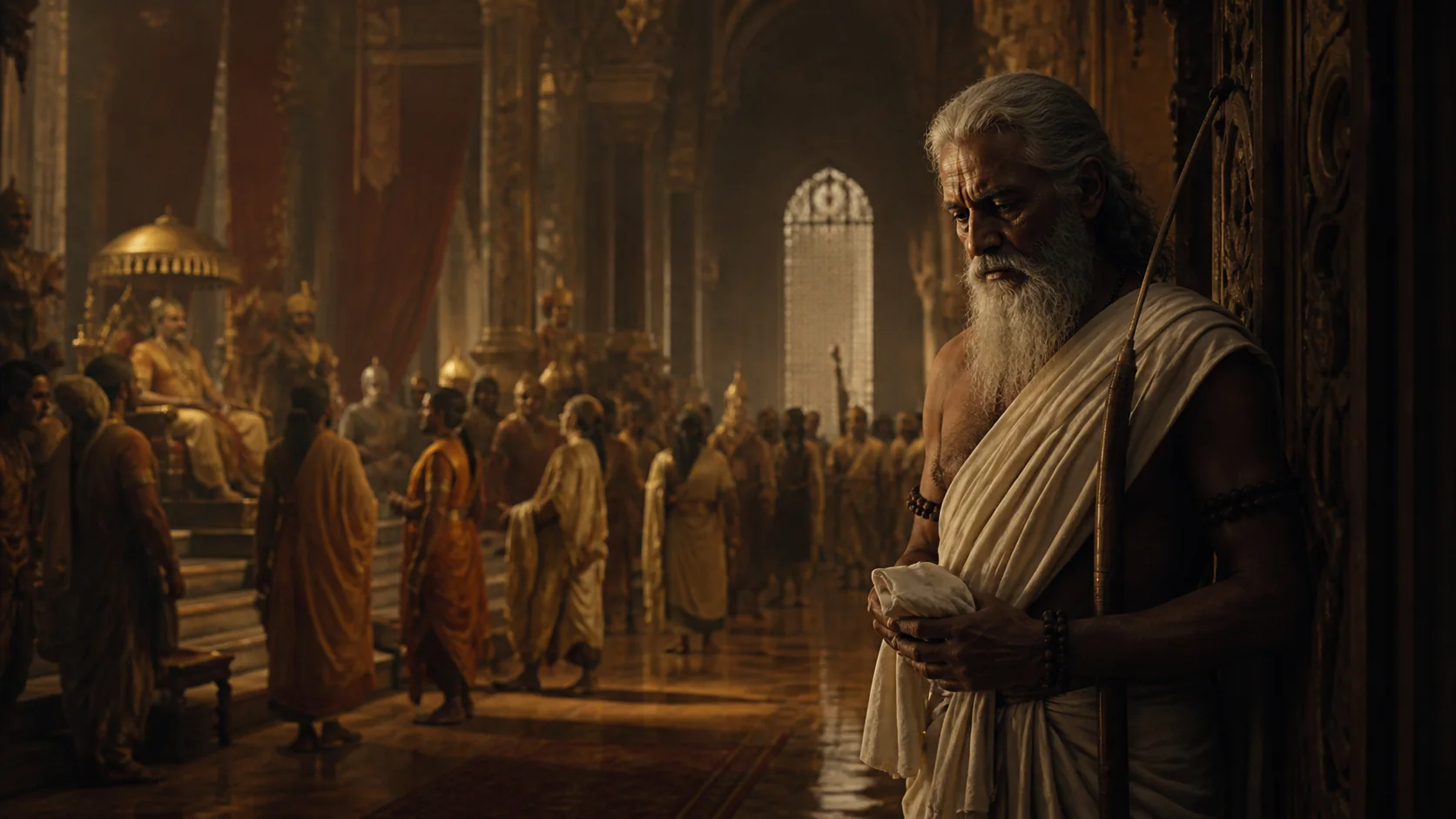
Imagine the court at the instant Devavrata becomes Bhishma. A son sees that his father’s desire cannot be fulfilled while the question of succession remains unsettled. He surrenders the throne, then goes further and renounces the possibility of children. The scene has the clean radiance of sacrifice: a difficult choice, a stunned court, a father overwhelmed by devotion. Yet life does not end at the moment a vow is admired. It continues into the mornings after it, into political emergencies the young prince could not have foreseen, and into the lives of people who never consented to pay its price. Hold the frame a little longer and the heroic gesture begins to cast a complicated institutional shadow.
The easy readings cancel one another. To call Bhishma merely wrong is to miss the love, discipline and courage inside the act. To call him simply great is to ignore what the act eventually disables. He becomes indispensable to the Kuru order and strangely unable to redirect it. His knowledge grows, but his room for moral movement shrinks. The vow is no longer one decision among others; it becomes the architecture of his identity. That is why reconsidering it would feel like more than changing his mind. It would mean losing the person he has spent a lifetime proving himself to be. In that fear, the epic figure becomes recognisably human.
The three long shadows of a vow
Bhishma gives up succession and family to secure his father’s happiness.
The vow slowly becomes an authority he can no longer question.
Private virtue cannot prevent public harm when it refuses to intervene.
Who pays for a promise?
Bhishma owns the vow, but he does not contain its consequences. The succession of a kingdom, the options available to future queens, and the political safety of people not yet born are all altered by one magnificent act. This creates a moral asymmetry that stories of sacrifice often hide. The person who renounces something receives the honour of renunciation, while other people inherit costs they never accepted. A responsible judgement must therefore look in two directions at once: inward, toward the courage and pain of the one who gives something up; and outward, toward the lives reorganised by that gift. Intention matters, but intention cannot be the only witness called to the court.
Sacrifice also creates authority. In families, the person who has done the most for everyone may acquire a moral weight that makes disagreement feel like ingratitude. The sentence is rarely spoken directly: after all I have done, how can you refuse me? Bhishma does not bargain for private advantage, yet the scale of his renunciation places him above ordinary challenge. His presence becomes a form of judgement even when he remains silent. This is why sacrifice must remain open to consent and review. Otherwise generosity can unintentionally become a currency of control, and reverence can prevent the very conversation that might keep a relationship or institution alive.
Wisdom without intervention
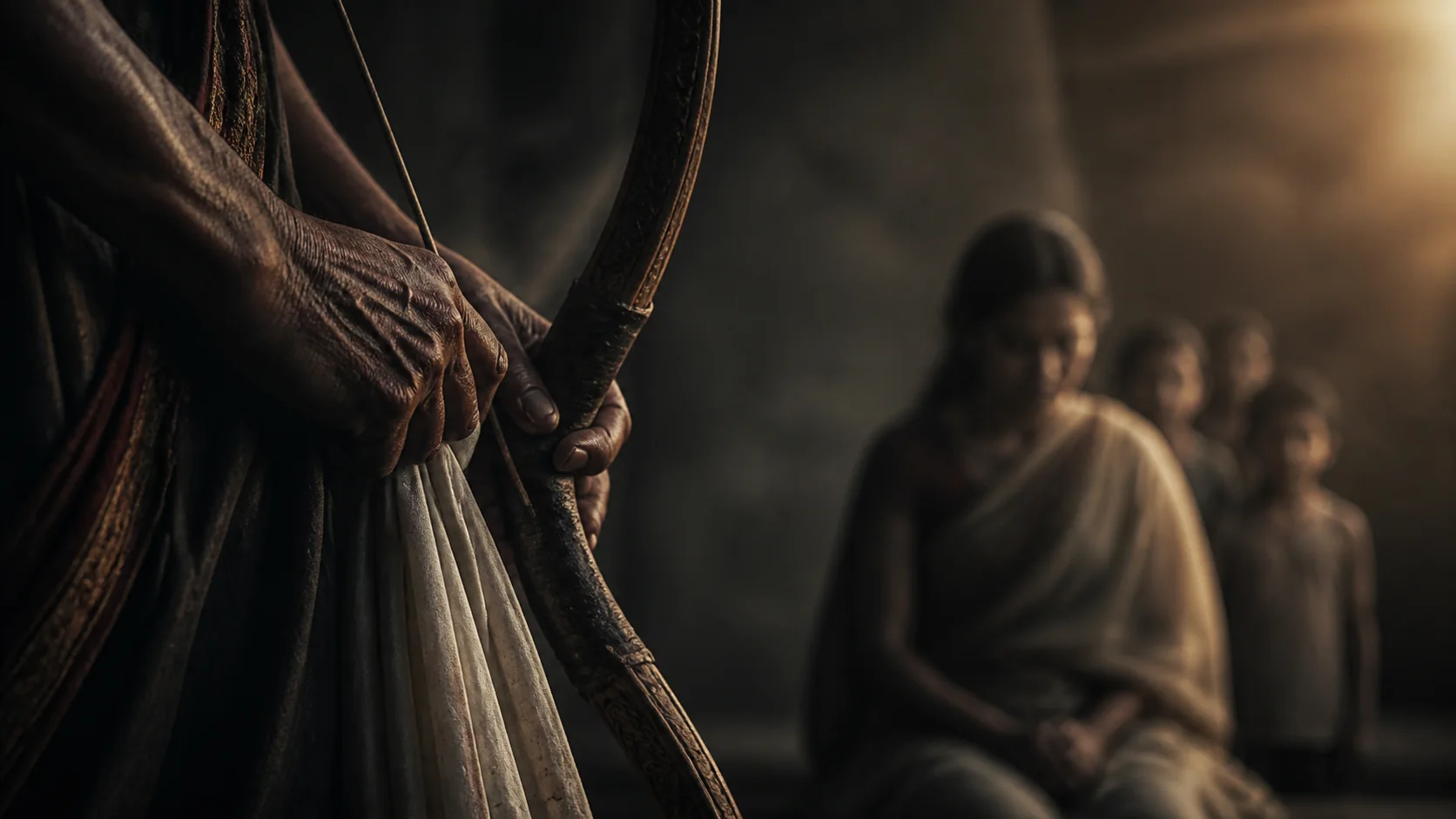
Bhishma occupies a painful position: he can diagnose disorder, explain duty and anticipate danger, but his own definition of loyalty limits decisive intervention. Knowledge then becomes commentary rather than action. This matters beyond the epic. We often assume that the most informed person in a room is also the most ethical. Yet knowing what is right and accepting the cost of doing it are different achievements. Moral intelligence is not completed by accurate analysis. It becomes real when judgement changes conduct, redistributes risk, or interrupts harm. Bhishma’s wisdom remains immense; the tragedy lies in the distance between what that wisdom can see and what his identity permits him to do.
The silence of a junior employee and the silence of a respected elder do not carry the same force. One may be produced by fear; the other may be interpreted as institutional approval. The higher a person’s standing, the more their refusal to intervene shapes the behaviour of everyone below them. That is why responsibility includes more than keeping one’s own actions formally clean. It includes the preventable harm that authority, access and credibility could have challenged. Bhishma reveals the danger of moral outsourcing: advising others to act while treating one’s own role as fixed. A vow cannot erase the responsibility created by power.
The counter-reading: what if Bhishma had refused?
A fair reading must resist judging the young Devavrata as though he already possesses the whole epic. He does not see Kurukshetra. He sees his father’s grief, a succession dispute and the possibility that competing claims may produce immediate conflict. His extreme renunciation may appear to him as the cleanest way to prevent bloodshed and secure the kingdom. To dismiss that act as vanity would flatten its courage and historical context. The problem is not simply that he makes the vow. The deeper problem is that a response designed for one emergency becomes immune to every later change in circumstance.
This distinction changes the lesson. Ethical growth does not require treating every old promise as an error. It requires separating the purpose of a commitment from its original wording. Bhishma might have preserved the purpose—stability, duty, protection of the realm—while revising how loyalty operated when the throne itself became an instrument of injustice. Mature fidelity can involve boundaries, exceptions and renewed interpretation. Such revision need not reduce his greatness. It makes the tragedy sharper: the strength that enabled the vow may also have made adaptation feel impossible.
A practical audit for an old promise
The choice is not limited to blind obedience or dramatic betrayal. An old commitment can be examined through five practical questions. What humane purpose did it originally serve? Does it still serve that purpose? Who now pays its cost? Can those people disagree without punishment or shame? Is there a way to change its application when new evidence appears? These questions do not weaken commitment. They return commitment to the moral reason that once made it valuable. A promise that protects love, stability or dignity should be strong enough to hear whether love, stability or dignity are actually being protected.
This audit matters in ordinary life. A parent’s promise to do everything for a child cannot become permanent control over the child’s adult choices. A professional’s decade of loyalty cannot purchase an employer’s ownership of every future year. Past investment does not eliminate present consent. Staying, changing a role and leaving are decisions that must be judged in the light of current reality, not as verdicts on whether the past was meaningful. The mature alternative to Bhishma’s prison is not carelessness. It is a form of fidelity that can change its method without abandoning its deepest ethical purpose.
The unease that survives beside Bhishma's greatness
Institutions are often weakened by beautiful private solutions to public problems. Bhishma resolves Shantanu’s immediate conflict through personal renunciation, but a dynasty cannot be secured by one man’s sacrifice. It needs a credible succession, distributed judgement, and the ability to correct decisions when circumstances change. Later, Bhishma repeatedly holds the kingdom together without repairing the structure that keeps producing crisis. He is the perfect custodian of an unstable order. Families and organisations know this figure well: the person who absorbs every shock, becomes impossible to replace, and thereby allows the underlying arrangement to avoid reform. Reliability can preserve a system; it can also preserve what is broken in it.
The court where Draupadi is humiliated is the severest test of this virtue. Learned elders recognise that something intolerable is happening, yet role, loyalty, legal ambiguity and allegiance to the throne interrupt action. Complexity is real, but it is not an alibi for allowing harm to continue. Neutrality in a scene of unequal power usually protects the side that already controls the room. Bhishma’s tragedy is not that his virtue turns him into a villain. It is that virtue, detached from intervention, fails the person directly in front of him. The episode forces an uncomfortable distinction between keeping one’s hands procedurally clean and accepting responsibility for what those hands could have stopped.
What an old vow asks of us now
Modern life repeatedly rewards Bhishma-like promises. A parent erases every private desire for a child. A partner turns endurance into proof of love. An employee promises to carry a project at any cost and gradually makes exhaustion part of professional identity. Some sacrifice is necessary and deeply humane. The danger begins when the promise removes the ability to say no, renegotiate a role, or respond to new evidence. A healthy commitment can be reviewed without being mocked. It asks whether the original purpose is still being served, who is now carrying the cost, and whether consent remains alive. A promise that cannot survive these questions has begun to rule the person who made it.
On the bed of arrows, Bhishma appears not only as a defeated warrior but as a man surrounded by the consequences of an old sentence. The image is powerful because it does not let us choose between reverence and criticism. He has kept his word with astonishing strength; he has also allowed that word to outlive the justice that first gave it meaning. Perhaps fidelity is not the preservation of every syllable spoken in the past. Perhaps it is fidelity to the moral purpose from which those syllables arose. When life changes, listening again may be the harder form of loyalty. The question Bhishma leaves us is intimate: which promise in my life still protects another person, and which one now protects only my image of myself? The answer cannot be found in self-accusation alone. It needs conversation with the people who carry the consequence, because a commitment may look heroic from the centre and feel suffocating at its edges. Moral revision begins when those edges are finally allowed to speak.
Specific takeaways
- 01
Good intention does not make a decision permanently just; consequences must remain open to review.
- 02
A healthy long-term commitment can be questioned without turning the questioner into a traitor.
- 03
The cost of sacrifice must include the experience of people who inherit its effects without consenting to them.
- 04
The silence of a respected elder is rarely neutral; others may read it as institutional permission.
- 05
An indispensable person may be protecting everyone, but may also be preventing a fragile system from being redesigned.
- 06
Fidelity is not always loyalty to old wording; it may be loyalty to the humane purpose that produced the words.
- 07
Bhishma’s lesson is not simply to break vows, but to keep purpose, application, power and human cost in continuous conversation.
Questions for your own life
- Which old commitment in my life still protects another person, and which now protects only my self-image?
- Do the people who carry the consequences of my sacrifice have a safe way to disagree with me?
- Where am I using role, policy or loyalty as a reason not to interrupt harm?
- If I preserved the purpose of a promise but changed its application, what would the first honest change look like?
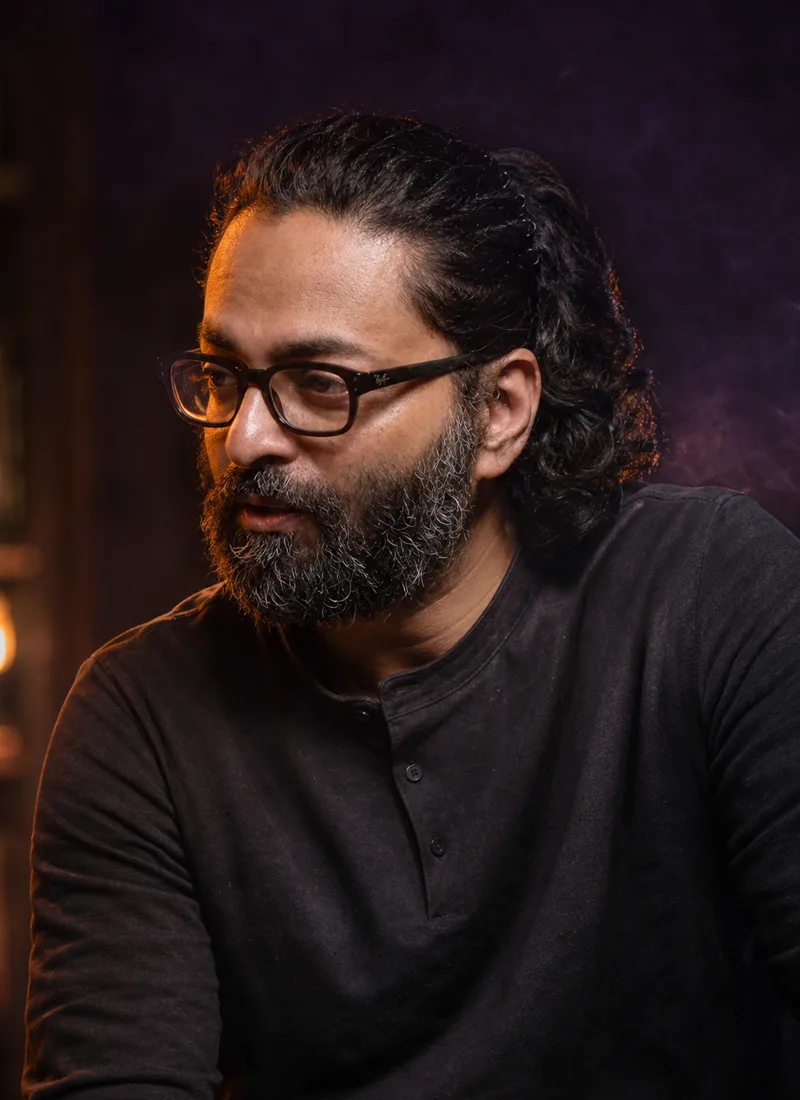
Arunava Khasnobis
In Soul Connection, Arunava looks at people, art, relationships, failure, moral tension and inner life through conversation. His essays are not episode summaries; they are honest returns to what was heard, tested against his own questions, experience and unfinished understanding.
CONTINUE READING